Cryptocurrency Investing Guide
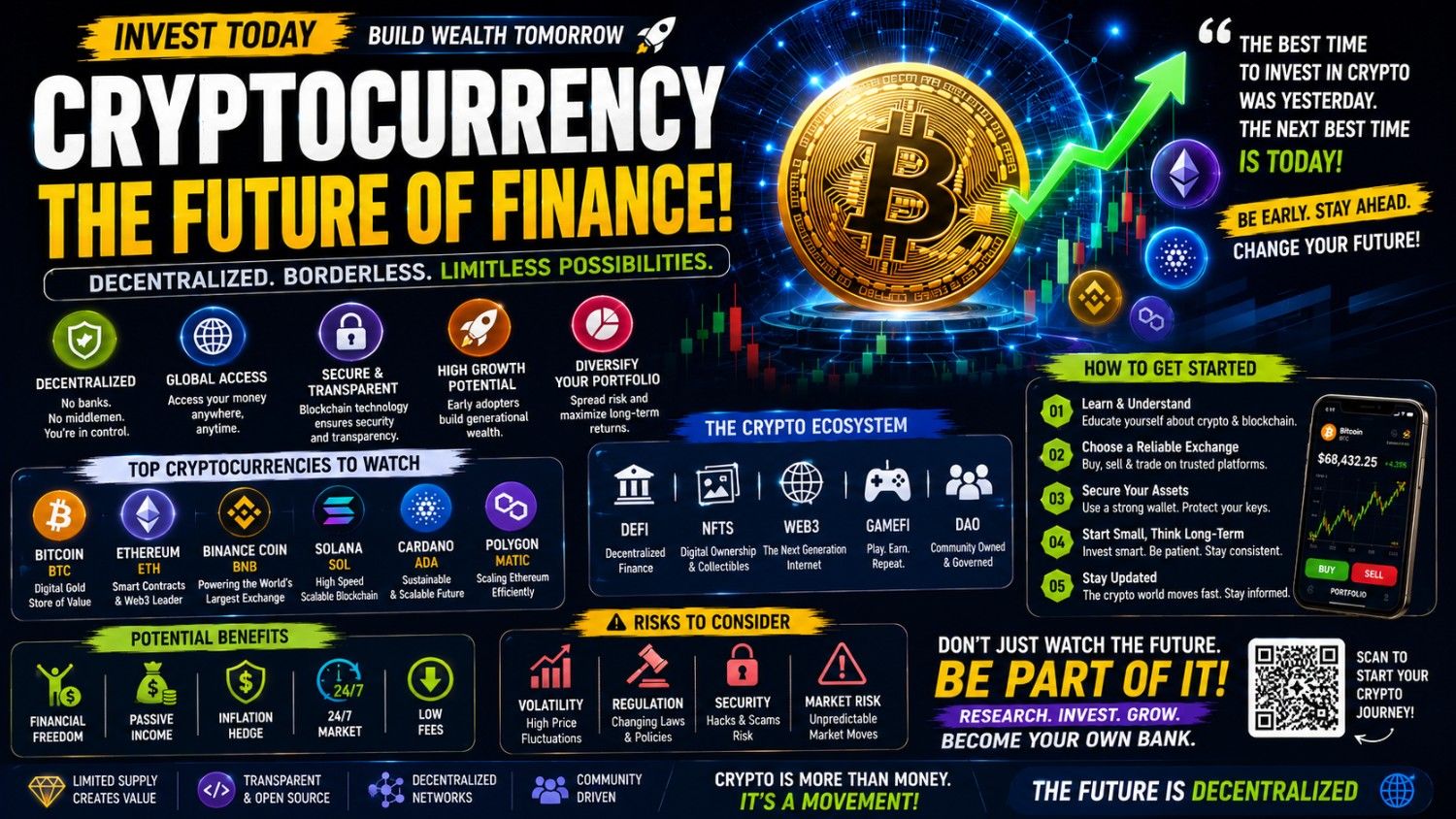
The Future of Digital Finance and Wealth Creation
The financial world is undergoing a massive transformation, and cryptocurrency is at the center of this revolution. Over the last decade, digital currencies have evolved from a niche technology experiment into a global financial asset class attracting investors, institutions, businesses, and governments.
Cryptocurrency has created new opportunities for wealth creation, financial inclusion, and decentralized financial services. As blockchain technology continues to advance, many experts believe that digital assets will play a significant role in the future of finance.
Whether you're a beginner exploring Bitcoin for the first time or an investor looking to diversify your portfolio, understanding cryptocurrency is essential in today's digital economy.
What is Cryptocurrency?
Cryptocurrency is a digital or virtual currency secured through cryptographic technology. Unlike traditional currencies issued by governments and central banks, cryptocurrencies operate on decentralized blockchain networks.
A blockchain is a distributed digital ledger that records all transactions transparently and securely.
Some of the most popular cryptocurrencies include:
Bitcoin (BTC)
Ethereum (ETH)
Solana (SOL)
Binance Coin (BNB)
XRP
Cardano (ADA)
Avalanche (AVAX)
Polygon (MATIC)
Each cryptocurrency serves different purposes within the digital asset ecosystem.
Why Cryptocurrency is Gaining Popularity
Cryptocurrencies have become increasingly popular due to their unique advantages compared to traditional financial systems.
Decentralization
Unlike banks and financial institutions, cryptocurrencies operate without central authority control.
Global Accessibility
Anyone with internet access can buy, sell, or transfer cryptocurrency regardless of location.
Transparency
Blockchain technology records transactions publicly, increasing trust and accountability.
Fast Transactions
Many crypto networks process transactions faster than traditional banking systems.
Investment Opportunities
Early adopters of major cryptocurrencies have experienced significant returns, attracting investors worldwide.
Understanding Blockchain Technology
Blockchain technology forms the foundation of cryptocurrency.
A blockchain consists of blocks containing transaction data that are linked together in chronological order.
Key benefits include:
Security
Transparency
Immutability
Decentralization
Efficiency
Beyond cryptocurrency, blockchain technology is being adopted across industries including healthcare, supply chain management, banking, and real estate.
Bitcoin: The Digital Gold
Bitcoin is the world's first and most valuable cryptocurrency.
Created in 2009, Bitcoin introduced the concept of decentralized digital money.
Many investors view Bitcoin as:
Digital Gold
Inflation Hedge
Store of Value
Long-Term Investment Asset
Due to its limited supply of 21 million coins, scarcity plays a major role in Bitcoin's value proposition.
Institutional investors and publicly traded companies have increasingly added Bitcoin to their investment portfolios.
Ethereum and Smart Contracts
Ethereum is the second-largest cryptocurrency by market capitalization.
Unlike Bitcoin, Ethereum offers programmable smart contracts that enable developers to create decentralized applications (dApps).
Ethereum powers:
Decentralized Finance (DeFi)
NFT Marketplaces
Blockchain Gaming
Web3 Applications
Decentralized Exchanges
Its flexibility has made Ethereum one of the most influential blockchain ecosystems in the world.
Crypto Investing Strategies
Successful crypto investing requires careful planning and risk management.
Long-Term Investing
Many investors adopt a "buy and hold" strategy by purchasing quality cryptocurrencies and holding them for several years.
Benefits include:
Reduced emotional trading
Long-term growth potential
Lower transaction costs
Dollar-Cost Averaging (DCA)
DCA involves investing fixed amounts regularly regardless of market conditions.
This strategy helps reduce the impact of market volatility.
Portfolio Diversification
Investors often spread investments across:
Bitcoin
Ethereum
Large-cap altcoins
Blockchain-related assets
Diversification can help reduce risk exposure.
Decentralized Finance (DeFi)
DeFi is one of the most innovative sectors within cryptocurrency.
DeFi platforms provide financial services without traditional banks.
Users can:
Earn interest
Borrow funds
Lend crypto assets
Trade tokens
Participate in liquidity pools
DeFi aims to create an open and accessible financial ecosystem for everyone.
Web3: The Next Generation Internet
Web3 represents the evolution of the internet powered by blockchain technology.
Unlike traditional platforms controlled by large corporations, Web3 emphasizes:
User ownership
Data privacy
Decentralization
Digital identity control
Many experts believe Web3 could reshape social media, gaming, content creation, and digital commerce.
Crypto Wallets and Security
A crypto wallet allows users to store and manage digital assets.
Popular wallet types include:
Hot Wallets
Connected to the internet and convenient for daily use.
Examples:
MetaMask
Trust Wallet
Coinbase Wallet
Cold Wallets
Offline storage devices offering enhanced security.
Examples:
Ledger
Trezor
Security best practices include:
Enabling two-factor authentication
Using strong passwords
Backing up recovery phrases
Avoiding phishing scams
Protecting digital assets is crucial for long-term investors.
Risks of Cryptocurrency Investing
While cryptocurrency offers significant opportunities, investors should understand potential risks.
Market Volatility
Crypto prices can experience large fluctuations within short periods.
Regulatory Changes
Government regulations can influence market sentiment and asset prices.
Security Risks
Hackers and scammers frequently target cryptocurrency users.
Technology Risks
Blockchain networks and smart contracts may contain vulnerabilities.
Proper research and risk management are essential before investing.
Future of Cryptocurrency
The future of cryptocurrency appears promising as adoption continues to grow.
Emerging trends include:
Central Bank Digital Currencies (CBDCs)
Many governments are exploring digital versions of national currencies.
Institutional Adoption
Major financial institutions increasingly offer crypto-related services.
Tokenization
Real-world assets such as real estate and stocks may become tokenized on blockchain networks.
Artificial Intelligence and Blockchain
AI and blockchain integration could create powerful new financial technologies.
Global Payments
Cryptocurrency may significantly improve international payment systems by reducing costs and increasing transaction speed.
How Beginners Can Start Investing
For beginners, the following steps provide a strong starting point:
Learn cryptocurrency basics.
Choose a reputable exchange.
Create a secure wallet.
Start with small investments.
Diversify your portfolio.
Focus on long-term growth.
Continue learning about blockchain technology.
Education is often the most valuable investment in the crypto market.
Conclusion
Cryptocurrency represents one of the most significant financial innovations of the modern era. From Bitcoin and Ethereum to decentralized finance and Web3 applications, digital assets are reshaping how people invest, transact, and interact online.
While risks exist, cryptocurrency also offers unique opportunities for wealth creation, financial independence, and participation in a rapidly growing digital economy. Investors who approach the market with proper education, risk management, and long-term thinking may benefit from the continued expansion of blockchain technology and digital finance.
As adoption increases and technology evolves, cryptocurrency is likely to remain a major force in the future of global finance. For individuals willing to learn and adapt, the crypto revolution presents exciting possibilities for growth and innovation.