Indian Stock Market Guide for Investment
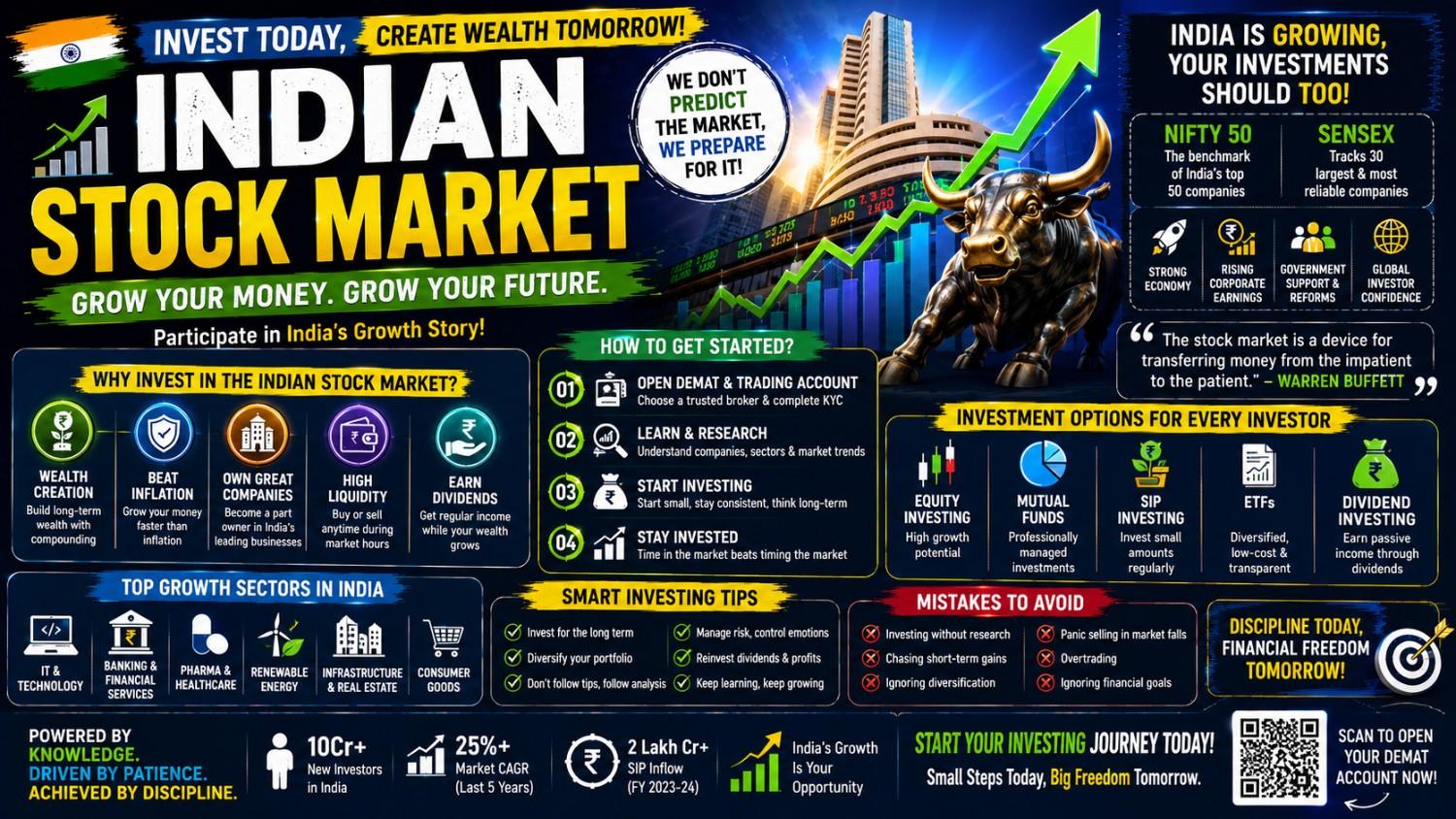
The Ultimate Guide to Wealth Creation and Financial Freedom
The Indian stock market has emerged as one of the fastest-growing investment destinations in the world. With a rapidly expanding economy, increasing retail investor participation, digital trading platforms, and strong corporate growth, the Indian stock market offers tremendous opportunities for wealth creation.
Over the past decade, millions of Indians have started investing in stocks, mutual funds, exchange-traded funds (ETFs), and systematic investment plans (SIPs). As financial awareness continues to grow, investing in the stock market is no longer limited to institutional investors and wealthy individuals. Today, anyone with a smartphone and internet connection can participate in India's growth story.
Whether you are a beginner looking to start investing or an experienced investor aiming to build long-term wealth, understanding the Indian stock market is essential for achieving financial success.
What is the Indian Stock Market?
The stock market is a marketplace where investors buy and sell shares of publicly listed companies. When you purchase a company's stock, you become a partial owner of that business.
India has two major stock exchanges:
National Stock Exchange (NSE)
The NSE is India's largest stock exchange by trading volume. Its benchmark index is the Nifty 50, which represents the top 50 companies listed on the exchange.
Bombay Stock Exchange (BSE)
The BSE is Asia's oldest stock exchange. Its benchmark index is the Sensex, consisting of 30 leading companies from various sectors.
Both exchanges play a crucial role in the country's financial ecosystem and economic growth.
Why Invest in the Indian Stock Market?
Investing in the stock market offers several advantages over traditional savings methods.
Wealth Creation
Historically, equities have outperformed most traditional investment options such as fixed deposits and savings accounts over the long term.
Beat Inflation
Inflation reduces the purchasing power of money over time. Stocks provide an opportunity to generate returns that exceed inflation rates.
Ownership in Businesses
Investors become shareholders in successful companies and participate in their growth journey.
Liquidity
Stocks can be bought and sold easily during market hours, making them highly liquid investments.
Dividend Income
Many established companies distribute profits to shareholders through regular dividend payments.
Understanding Nifty 50 and Sensex
Nifty 50
The Nifty 50 is India's most widely tracked stock market index. It includes leading companies from sectors such as:
Banking
Information Technology
Pharmaceuticals
FMCG
Energy
Financial Services
Telecommunications
Sensex
The Sensex represents 30 large and financially strong companies listed on the BSE.
Both indices serve as indicators of overall market performance and investor sentiment.
How to Start Investing in the Indian Stock Market
Starting your investment journey has become easier than ever.
Open a Demat Account
A Demat account allows investors to hold shares electronically.
Popular stock brokers include:
Zerodha
Groww
Upstox
Angel One
ICICI Direct
Complete KYC Verification
Investors must complete Know Your Customer (KYC) requirements using PAN, Aadhaar, and bank details.
Research Before Investing
Understanding a company's business model, financial performance, and future growth prospects is crucial before investing.
Start Small
Beginners should begin with modest investments while learning about market behavior and risk management.
Best Investment Strategies for Beginners
Long-Term Investing
Long-term investing remains one of the most successful wealth-building strategies.
Benefits include:
Compounding returns
Reduced trading costs
Lower emotional decision-making
Better risk management
Many successful investors focus on holding quality companies for years rather than chasing short-term gains.
SIP Investing
Systematic Investment Plans (SIPs) allow investors to invest fixed amounts regularly in mutual funds.
Advantages:
Disciplined investing
Rupee cost averaging
Long-term wealth accumulation
Suitable for salaried individuals
Diversification
Investors should avoid putting all their money into a single stock or sector.
Diversification can include:
Large-cap stocks
Mid-cap stocks
Mutual funds
ETFs
International investments
Top Sectors Driving India's Growth
Several sectors are contributing significantly to India's economic expansion.
Information Technology
India remains a global leader in software services and digital transformation.
Banking and Financial Services
The financial sector continues to benefit from rising credit demand and digital banking adoption.
Renewable Energy
Government initiatives are accelerating investments in solar, wind, and green energy projects.
Pharmaceuticals
India is one of the world's largest producers of generic medicines and healthcare solutions.
Infrastructure
Massive government spending on roads, railways, airports, and urban development is creating growth opportunities.
Mutual Funds vs Direct Stock Investing
Many beginners struggle to choose between mutual funds and direct stock investments.
Mutual Funds
Professional fund managers handle investment decisions.
Benefits include:
Diversification
Professional management
Lower risk
Suitable for beginners
Direct Stocks
Investors select and manage their own portfolio.
Benefits include:
Higher return potential
Greater control
Dividend income
Customized strategy
The choice depends on individual goals, knowledge, and risk tolerance.
Common Mistakes Investors Should Avoid
Investing Without Research
Buying stocks based on rumors or social media tips can lead to losses.
Panic Selling
Market corrections are normal. Emotional decisions often hurt long-term returns.
Chasing Quick Profits
Many investors lose money trying to predict short-term price movements.
Ignoring Risk Management
Proper asset allocation and diversification are essential for protecting capital.
Following Market Hype
Investors should focus on fundamentals rather than speculative trends.
Role of Financial Planning
Stock market investing works best when integrated into a broader financial plan.
Financial planning should include:
Emergency Fund
Insurance Coverage
Retirement Planning
Tax Planning
Investment Goals
A well-structured financial plan increases the probability of long-term success.
Taxation on Stock Market Investments
Understanding taxation helps investors optimize returns.
Short-Term Capital Gains (STCG)
Applicable when shares are sold within a specified short-term holding period.
Long-Term Capital Gains (LTCG)
Applicable when investments are held for longer durations.
Dividend Taxation
Dividend income may be subject to applicable tax regulations.
Investors should stay updated on changing tax rules and consult professionals when needed.
Future of the Indian Stock Market
India is expected to become one of the world's largest economies in the coming decades.
Several factors support long-term market growth:
Rising middle-class population
Increasing digital adoption
Strong corporate earnings
Infrastructure development
Government reforms
Growing foreign investments
As more Indians participate in financial markets, the investment ecosystem is likely to become stronger and more accessible.
Building Wealth Through Discipline
Successful investing is not about finding the next multibagger overnight. It is about consistency, patience, and disciplined decision-making.
Investors who:
Invest regularly
Stay invested long-term
Diversify properly
Avoid emotional decisions
Continue learning
are more likely to achieve financial independence and wealth creation.
Conclusion
The Indian stock market offers incredible opportunities for investors willing to adopt a long-term perspective. Whether through direct equity investments, mutual funds, SIPs, or ETFs, individuals can participate in India's economic growth and build substantial wealth over time.
The key to success lies in financial education, disciplined investing, proper diversification, and patience. As India continues its journey toward becoming a global economic powerhouse, investors who start early and remain committed to their goals can benefit significantly from the wealth-creating power of the stock market.
Remember, investing is not about timing the market—it's about spending time in the market.